 Forum on Child and Family Statistics
Asthma
Asthma is a disease of the lungs that can cause wheezing, difficulty breathing, and chest pain. It is one of the most common chronic diseases among children. Asthma varies greatly in severity. Some children who have been diagnosed with asthma may not experience any serious respiratory effects. Other children may have mild symptoms or may respond well to the management of their asthma, typically through the use of medication. However, some children with asthma may suffer serious attacks that greatly limit their activities; result in visits to emergency rooms or hospitals; or, in rare cases, cause death. Environmental factors such as air pollution and secondhand tobacco smoke, along with infections, exercise, and allergens, can trigger asthma attacks in children who have the disease.1, 2, 3, 4, 5, 6
Indicator HEALTH6 Percentage of children ages 0–17 with asthma, 2009–2024
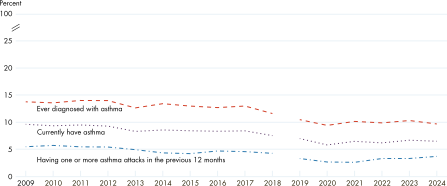
NOTE: Children are identified as ever diagnosed with asthma by asking parents, "Has a doctor or other health professional EVER told you that [child's name] had asthma?" If the parent responds "yes" to this question, they are then asked (1) "Does [child's name] still have asthma?" and (2) "During the past 12 months, has [child's name] had an episode of asthma or an asthma attack?" The question "Does [child's name] still have asthma?" was introduced in 2001 and identifies children who currently have asthma. In 2019, the National Health Interview Survey (NHIS) questionnaire was redesigned and other changes were made to weighting and design methodology. Therefore, data for 2019 are not strictly comparable with data for earlier years. For more information on the 2019 NHIS redesign, see https://www.cdc.gov/nchs/data/nhis/earlyrelease/EReval202009-508.pdf.
SOURCE: National Center for Health Statistics, National Health Interview Survey.
- In 2024, 10% of children ages 0–17 had ever been diagnosed with asthma at some point in their lives. This percentage has remained steady since 2019, when 11% of children had ever been diagnosed with asthma.
- In 2024, 4% of children had one or more asthma attacks in the past year. This percentage has remained steady since 2019, when 3% of children had one or more asthma attacks in the past year.
- In 2024, 7% of children currently had asthma. This percentage was highest among Black, non-Hispanic children (10%), followed by children who were Hispanic (7%); White, non-Hispanic (6%); and Asian, non-Hispanic (4%).
- In 2024, 8% of children living below the poverty level had asthma, compared with 6% of children with family incomes at or above 200% of the poverty level.
 HEALTH6.A HTML Table | HEALTH6.B HTML Table
1 U.S. Environmental Protection Agency. (2020). Integrated science assessment for ozone and related photochemical oxidants (EPA/600/R-20/012). https://cfpub.epa.gov/ncea/isa/recordisplay.cfm?deid=348522
2 U.S. Environmental Protection Agency. (2019). Integrated science assessment for particulate matter. https://cfpub.epa.gov/ncea/isa/recordisplay.cfm?deid=347534
3 U.S. Department of Health and Human Services. (2006). The health consequences of involuntary exposure to tobacco smoke: A report of the Surgeon General. Centers for Disease Control and Prevention, Coordinating Center for Health Promotion, National Center for Chronic Disease Prevention and Health Promotion, Office on Smoking and Health. https://www.ncbi.nlm.nih.gov/books/NBK44324/
4 Institute of Medicine. (2000). Clearing the air: Asthma and indoor air exposures. National Academy Press. http://books.nap.edu/catalog/9610.html
5 Gern, J. E. (2004). Viral respiratory infection and the link to asthma. The Pediatric Infectious Disease Journal, 23(1 Suppl.), S78–S86. https://journals.lww.com/pidj/fulltext/2008/10001/viral_respiratory_infection_and_the_link_to_asthma.13.aspx
6 Lemanske, R. F., Jr., & Busse, W. W. (2003). Asthma. Journal of Allergy and Clinical Immunology, 111(2 Suppl.), S502– S519. https://www.jacionline.org/action/showPdf?pii=S0091-6749%2802%2991356-4
Federal Interagency Forum on Child and Family Statistics
