 Forum on Child and Family Statistics
Preterm Birth and Low Birthweight
Infants born preterm (less than 37 completed weeks of gestation) or with low birthweight (less than 2,500 grams, or 5 lb 8 oz) are at higher risk of early death and long-term health and developmental issues than infants born later in pregnancy or at higher birthweights.1, 2, 3 Many but not all preterm infants also are low birthweight, and vice versa. Preterm infants born at less than 34 weeks (early preterm) are at high risk for poor outcomes, including chronic health conditions, long-term disability, and death.2, 4 The majority of preterm births are infants born at 34–36 weeks (late preterm). Late preterm infants are at a lower risk of poor outcomes than infants born earlier but are at a higher risk than infants delivered at term or later.2 The increasing multiple birth rate was a contributing factor to the rise in preterm birth and low birthweight in the past decade. However, preterm birth and low-birthweight levels also increased substantially among singleton births during this period.5 Disorders related to preterm birth and low birth weight are the second leading cause of infant death in the United States.1
Indicator HEALTH1.A Percentage of infants born preterm and percentage of infants born with low birthweight, 2013–2023
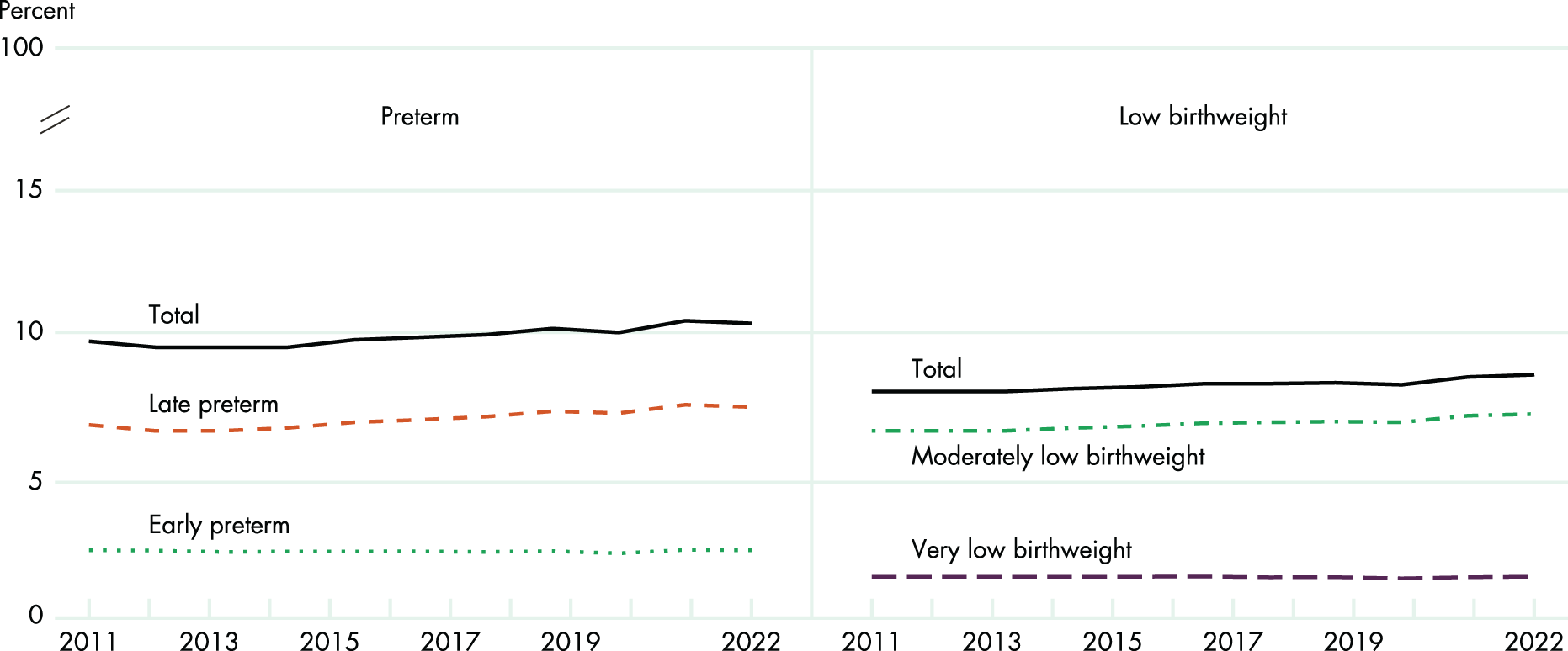
NOTE: Late preterm infants are born at 34–36 weeks of gestation; early preterm infants are born at less than 34 weeks of gestation. Moderately low-birthweight infants weigh 1,500–2,499 grams at birth; very low-birthweight infants weigh less than 1,500 grams at birth. Gestational age is estimated using the obstetric estimate of gestational delivery. Data on low birthweight can be found in table HEALTH1.B.
SOURCE: National Center for Health Statistics, National Vital Statistics System—Natality.
- The percentage of infants born preterm (less than 37 completed weeks of gestation) increased from 9.6% in 2013 to 10.4% in 2023.
- The percentage of infants born late preterm (34–36 completed weeks of gestation) increased from 6.8% in 2013 to 7.7% in 2021 and then remained stable through 2023 (7.6%).
- The percentage of infants born early preterm (less than 34 completed weeks of gestation) remained stable between 2013 and 2023 (2.8%).
- The percentage of infants born with low birthweight (less than 2,500 grams, or 5 lb 8 oz) increased from 8.0% in 2013 to 8.6% in 2023.
- From 2013 to 2023, the percentage of infants born with moderately low birthweight increased (7.2% in 2023), while the percentage of infants born with very low birthweight decreased (1.4% in 2023).
Indicator HEALTH1.B Percentage of infants born with low birthweight by race and Hispanic origin of mother, 2016 and 2023
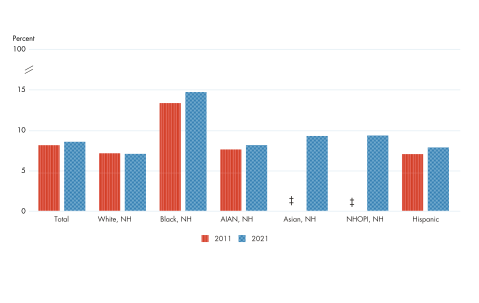
NOTE: NH = non-Hispanic origin; AIAN = American Indian or Alaska Native; NHOPI = Native Hawaiian or Other Pacific Islander. Race and Hispanic origin refer to the mother's race and Hispanic origin. The 1997 U.S. Office of Management and Budget standards for data on race and ethnicity were used to classify people into one of the following five racial groups: White; Black or African American; Asian; American Indian or Alaska Native; or Native Hawaiian or Other Pacific Islander. All categories are single race. Data on race and Hispanic origin are collected and reported separately. People of Hispanic origin may be of any race.
SOURCE: National Center for Health Statistics, National Vital Statistics System—Natality.
- In 2023, Black, non-Hispanic women were the most likely to have a low-birthweight infant (15%), compared with American Indian or Alaska Native, non-Hispanic (9%); Asian, non-Hispanic (9%); Native Hawaiian or Other Pacific Islander, non-Hispanic (9%); Hispanic (8%); and White, non-Hispanic (7%) women.
- Between 2016 and 2023, the percentage of low-birthweight infants increased for all race and Hispanic origin groups.
 HEALTH1.A HTML Table | HEALTH1.B HTML Table
1 Ely, D. M., & Driscoll, A. K. (2023). Infant mortality in the United States, 2021: Data from the period linked birth/infant death file. National Vital Statistics Reports, 72(11). National Center for Health Statistics. https://dx.doi.org/10.15620/cdc:131356
2 Institute of Medicine, Committee on Understanding Premature Birth and Assuring Healthy Outcomes and Board on Health Sciences Policy. (2007). Preterm birth: Causes, consequences, and prevention. The National Academies Press. https://doi.org/10.17226/11622
3 Vogel, J. P., Chawanpaiboon, S., Moller, A. B., Watananirun, K., Bonet, M., & Lumbiganon, P. (2018). The global epidemiology of preterm birth. Best Practice & Research Clinical Obstetrics & Gynaecology, 52, 3–12. https://doi.org/10.1016/j.bpobgyn.2018.04.003
4 Eichenwald, E. C., & Stark, A. R. (2008). Management and outcomes of very low birth weight. New England Journal of Medicine, 358(16), 1700–1711. https://doi.org/10.1056/NEJMra0707601
5 Osterman, M. J. K., Hamilton, B. E., Martin, J. A., Driscoll, A. K., & Valenzuela, C. P. (2024). Births: Final data for 2022. National Vital Statistics Reports, 73(2). National Center for Health Statistics. https://dx.doi.org/10.15620/cdc:145588
Federal Interagency Forum on Child and Family Statistics
