 Forum on Child and Family Statistics
Illicit Drug Use
Drug use by adolescents can have immediate and long-term health and social consequences. Marijuana use may have a wide range of effects, both physical and mental, including cognitive risks.1, 2 It is also the main driver of illicit drug use among teens, with an estimated one in six high school seniors (i.e., 12th-graders) reporting use in the past month. Other drug use, such as the misuse of prescription and over-the-counter drugs, can increase the risk of adverse health effects, including overdose—especially when taken in combination with other drugs, like alcohol. Hallucinogens, such as MDMA, can affect brain chemistry and may result in problems with memory and learning new information.3 Any illicit drug use during adolescence is a risk-taking behavior that has potentially serious negative consequences. In this indicator, use of any illicit drug in 12th grade is defined as any use in the past 30 days of marijuana, LSD, other hallucinogens, crack, other cocaine, heroin, or any use of other narcotics, amphetamines, barbiturates, or tranquilizers not under a doctor's orders. In 8th and 10th grade, the use of other narcotics and barbiturates has been excluded because these younger respondents appear to overreport use.
Indicator BEH3.A Percentage of 8th-, 10th-, and 12th-grade students who reported using illicit drugs in the past 30 days by grade, 2000–2024
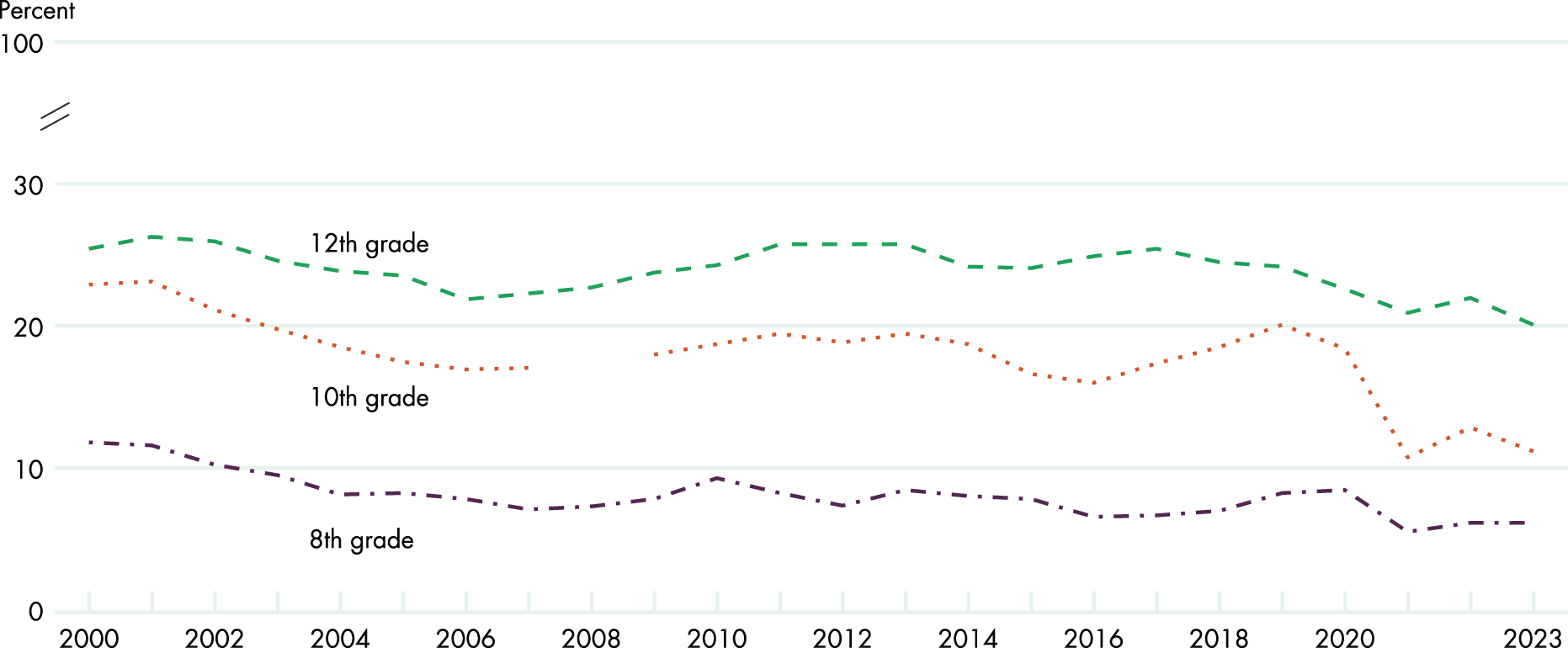
NOTE: Use of "illicit drugs" includes any use of marijuana, LSD, other hallucinogens, crack, other cocaine, or heroin or any use of other narcotics, amphetamines, barbiturates, or tranquilizers not under a doctor's orders. For 8th- and 10th-graders, the use of other narcotics and barbiturates is excluded because younger respondents appear to overreport use (perhaps because they include the use of nonprescription drugs in their responses). Data for 10th-graders for 2008 are not included because estimates are considered to be unreliable due to sampling errors. See https://monitoringthefuture.org/wp-content/uploads/2022/08/overview2009.pdf#page=9. Some estimates have been revised from previous publications.
SOURCE: National Institute on Drug Abuse, Monitoring the Future Survey.
Indicator BEH3.B Percentage of 8th-, 10th-, and 12th-grade students who reported using marijuana in the past 30 days by grade, 2000–2024

NOTE: Data for 10th-graders for 2008 are not included because estimates are considered to be unreliable due to sampling errors. See https://monitoringthefuture.org/wp-content/uploads/2022/08/overview2009.pdf#page=9.
SOURCE: National Institute on Drug Abuse, Monitoring the Future Survey.
- In 2024, illicit drug use in the past 30 days was reported by 5% of 8th-graders, 10% of 10th-graders, and 17% of 12th-graders. These estimates were not significantly different from those in 2023 for 8th- and 10th-graders. For 12th-graders, the estimate reflects a significant decrease compared with 2023 (20%).
- In 2024, illicit drug use in the past 30 days was reported by 5% of both male and female 8th-graders, 10% of both male and female 10th-graders, and 15% of male and 16% of female 12th-graders.
- In 2024, marijuana use in the past 30 days was reported by 4% of 8th-graders, 10% of 10th-graders, and 16% of 12th-graders. Rates remained stable compared with 2023.
 BEH3.A HTML Table | BEH3.B HTML Table
1 National Institute on Drug Abuse (2024). Cannabis (marijuana). https://nida.nih.gov/research-topics/cannabis-marijuana
2 Pope, H. G., Jr., & Yurgelun-Todd, D. (1996). The residual cognitive effects of heavy marijuana use in college students. Journal of the American Medical Association, 275(7), 521–527. https://doi.org/10.1001/jama.275.7.521
3 National Institute on Drug Abuse. (2024). Psychedelic and Dissociative Drugs. United States Department of Health and Human Services, National Institutes of Health. https://nida.nih.gov/research-topics/psychedelic-dissociative-drugs
Federal Interagency Forum on Child and Family Statistics
