 Forum on Child and Family Statistics
Infant Mortality
Infant mortality is defined as the death of an infant before his or her first birthday. Infant mortality is related to the underlying health of the mother, public health practices, socioeconomic conditions, and the availability and use of appropriate health care for infants and pregnant women.1, 2 Despite medical advances and public health efforts, the mortality rates of Black, non-Hispanic; American Indian or Alaska Native, non-Hispanic; and Native Hawaiian or Other Pacific Islander, non-Hispanic infants have been consistently higher than the rates of other racial and ethnic groups.3, 4 Higher rates of infants born preterm or at low birthweight account for most of the deaths among Black, non-Hispanic infants.3 Higher rates of birth defects account for many of the deaths among American Indian or Alaska Native, non-Hispanic infants.3
Indicator HEALTH2 Death rates among infants by race and Hispanic origin of mother, 2017–2022
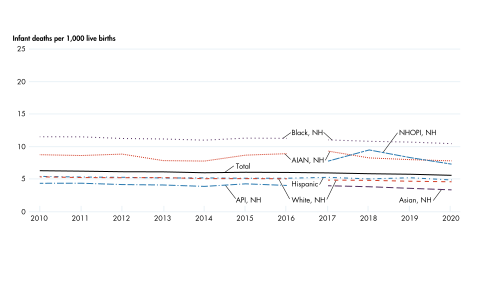
NOTE: NH = non-Hispanic origin; AIAN = American Indian or Alaska Native; NHOPI = Native Hawaiian or Other Pacific Islander. Infant deaths are deaths before an infant's first birthday. Race and Hispanic origin refer to the mother's race and Hispanic origin. The 1997 U.S. Office of Management and Budget standards for data on race and ethnicity were used to classify people into one of the following five racial groups: White; Black or African American; Asian; American Indian or Alaska Native; or Native Hawaiian or Other Pacific Islander. All categories are single race. Data on race and Hispanic origin are collected and reported separately. People of Hispanic origin may be of any race.
SOURCE: National Center for Health Statistics, National Vital Statistics System—Linked Birth/Infant Death Data Set.
- The infant mortality rate did not significantly change from 2017 to 2022. In 2022, the mortality rate was 6 infant deaths per 1,000 live births.
- From 2017 to 2022, the mortality rate did not significantly change for infants of any race or Hispanic origin group.
- In 2022, the mortality rate was highest for infants of Black, non-Hispanic women (11 per 1,000), followed by infants of American Indian or Alaska Native, non-Hispanic (9 per 1,000) and Native Hawaiian or Other Pacific Islander, non-Hispanic (8 per 1,000) women. The mortality rate was lowest for infants of Hispanic (5 per 1,000); White, non-Hispanic (5 per 1,000); and Asian, non-Hispanic (4 per 1,000) women.

1 Osterman, M. J. K., Hamilton, B. E., Martin, J. A., Driscoll, A. K., & Valenzuela, C. P. (2024). Births: Final data for 2022. National Vital Statistics Reports, 73(2). National Center for Health Statistics. https://dx.doi.org/10.15620/cdc:145588
2 Ely, D. M., Driscoll, A. K., & Mathews, T. J. (2018). Infant mortality by age at death in the United States, 2016 (NCHS Data Brief No. 326). National Center for Health Statistics. https://www.cdc.gov/nchs/data/databriefs/db326-h.pdf
3 Ely, D. M., & Driscoll, A. K. (2025). Infant mortality in the United States, 2023: Data from the period linked birth/infant death file. National Vital Statistics Reports, 74(7). National Center for Health Statistics. https://www.cdc.gov/nchs/data/nvsr/nvsr74/nvsr74-07.pdf
4 Mathews, T. J., & Driscoll, A. K. (2017). Trends in infant mortality in the United States, 2005–2014 (NCHS Data Brief No. 279). National Center for Health Statistics. https://www.cdc.gov/nchs/data/databriefs/db279.pdf
Federal Interagency Forum on Child and Family Statistics
